
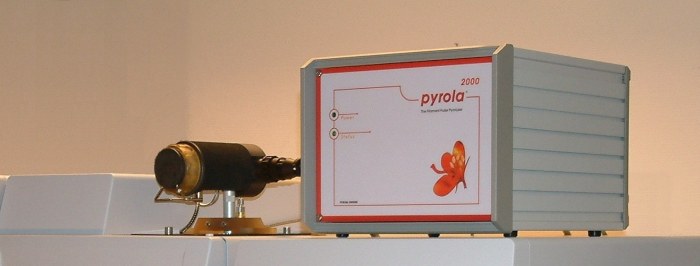
Read more about the design philosophy for the Pyrola pyrolyzers in this menu.
The Pyrola pyrolyzers are not designed by chance. Rather they are designed to maximize the precision, user-friendliness and versatility for the analytical chemist. The foundation is the choice of heating element, the platinum filament, and the positioning of the sample in direct contact with the filament. This gives both uncomplicated sample handling and the possibility of pyrolysis methods unavailable with other means of heating.
Furthermore the measurement of the true temperature time profile gives the analytical chemist total control of the pyrolysis process.
For more information use the submenu, the shortcuts on the sidebar or the arrows below to reach the other articles.
A lesser known fact of analytical pyrolysis is that the temperature rise time is just as important as the final temperature. Why? Because the key to precision is that the pyrolysis occurs at a well-defined temperature. If the temperature rise is slow the sample will be pyrolyzed already during heating, and “slow” in this context means in comparison to the half-decomposition time of the sample. Fast temperature rise time means that higher pyrolysis temperatures can be used, and the pyrolysis time can be optimised. A more detailed explanation is given in the menu under About pyrolysis.
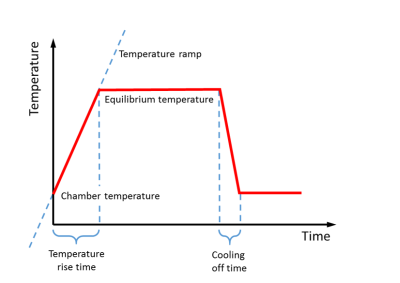
Just as important is a fast cooling time. When the temperature drops fast the pyrolysis is halted instantly, and more information can be extracted by pyrolysing the same sample again at a higher temperature. This is called fractionated pyrolysis. In the Pyrola pyrolyzers only the filament and the sample is heated, and the pyrolysis products are instantly transferred to the separation column by the carrier gas. The temperature drops rapidly without the need for cooling gas.There is no faster way of heating a sample than to put it in direct contact with the heating element. For the Pyrola pyrolyzers the sample is put in direct contact with the filament, which is heated by a powerful electric pulse. The temperature can be raised to 1400 degrees in 8 milliseconds.
The Pyrola pyrolyzers are designed for usability and flexibility. The sample handling is streamlined and straightforward. The Pyrola process unit can be installed on any GC, and may be removed in seconds should need arise. It can be installed on any injector port, and can be mounted beside an autosampler of moderate size.
No consumables are needed, and no cooling gas. The platinum filament and glass cell are cleaned by heat, and are used over and over again. The instrument is serviceable by the user, for example replacement of a broken filament or sealing septa. After replacing the filament the pyrolysis temperatures are calibrated by the user in a straightforward process.
Since the Pyrola pyrolyzers can pyrolyze the same sample several times, the temperatures can be optimised. There is no need for a cryotrap to focus the pyrolysis products, even for complex samples.
The Pyrola pyrolyzers are designed for maximum precision. As the only pyrolyzer on the market it measures the true pyrolysis temperature. Two independent methods are used: it measures the light emitted from the heated filament which is in direct contact with the sample, and it measures the resistance of the filament, which is temperature dependent. The temperature time profile is recorded for every pyrolysis, and even small variations in temperature due to sample size or exothermic or endothermic reactions during pyrolysis are registered. A small variation of the temperature time profile can change the results significantly.
Exact control over the pyrolysis conditions is a requirement for quantitative analyses and makes it possible to compare results between different instruments and different laboratories, see the figure above.
Factors causing variations in pyrolysis conditions are minimized. The sample is placed on the filament which is flushed by the carrier gas flow. No glass tube, wool or metal cup is restricting the pyrolysis products path to the GC injector.
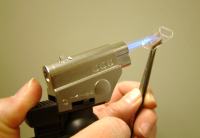
Special sample handlers are provided to ensure consistent sample sizes of liquid, solid and powdered samples. A quartz glass cell protects the pyrolyzer from residues, and is easily cleaned by heating with a microtorch.
The Pyrola pyrolyzers are designed for versatility. The pyrolysis conditions may be varied widely, and there is a variety of pyrolysis methods.
Isothermal pyrolysis
For isothermal pyrolysis the sample can be heated up to a maximum temperature of 1400°C in 8 milliseconds.
Thermal desorption
If the sample contains both volatile and non-volatile components it may be heated at a low temperature prior to pyrolysis to evaporate the volatiles. They can then be analysed separately.
Fractionated pyrolysis
The unique design of the Pyrola pyrolyzers makes it possible to pyrolyze the same sample several times at increasing temperatures without reloading.
Fast heating and cooling of the sample results in pyrograms at very well defined temperatures. By contrast, a slower heating and cooling will result in a “mixed” pyrogram of products from a wide temperature range. In fractionated pyrolysis each pyrolysis lasts typically 2 seconds, making a cryotrap unnecessary to focus the pyrolysis products prior to GC analysis.
Sequential pyrolysis
Sequential pyrolysis is tailor-made for kinetic studies of formation rates. The same sample is pyrolyzed repeatedly at the same temperature until the whole sample is degraded. By the precise control of the pyrolysis conditions the reaction rate can be derived. The procedure can be repeated at several temperatures.
Pyrotomy
The heating and cooling is so fast that short heating pulses down to 100 milliseconds can be used. Then only the portion of the sample in direct contact with the filament gets pyrolyzed. This method is called pyrotomy and is useful for studying surface treatments or laminates.
- You are here:
-
Home

- Design principles